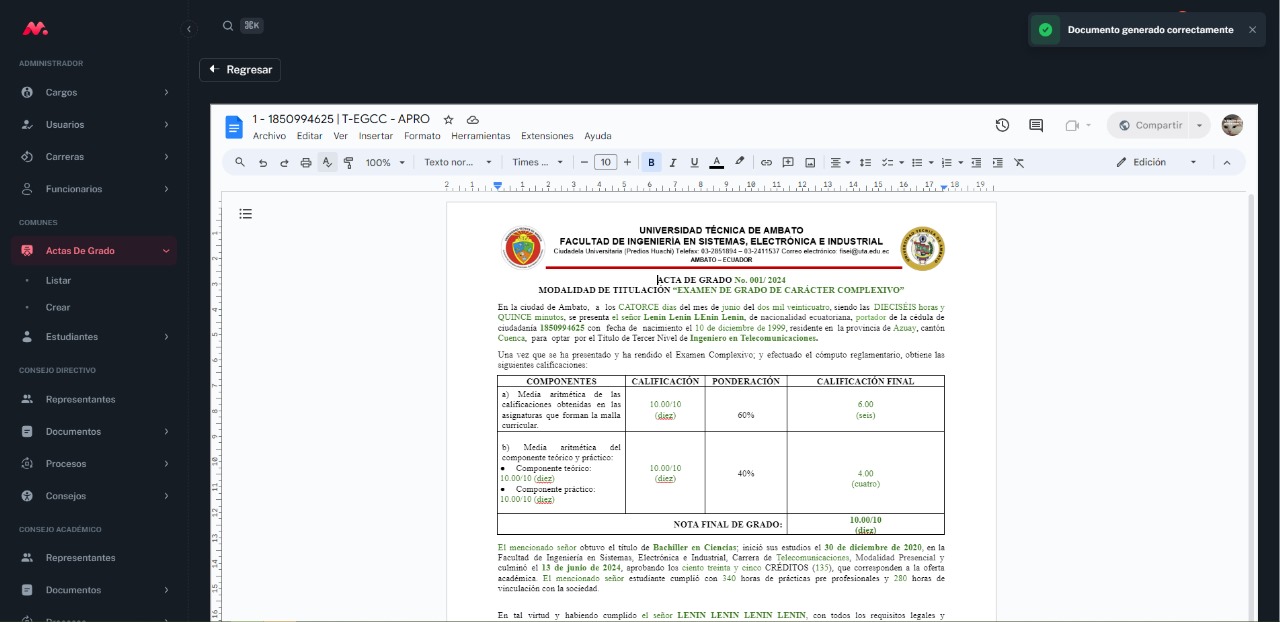
Project Description
GenDocs V3 is an integrated document automation platform built for the School of Software Engineering at the Technical University of Ambato. It replaced a manual, copy-paste workflow for administrative paperwork — letters, certificates, formal academic documents — with a templated, event-driven pipeline that talks to the Google Docs API and delivers finished documents via email and in-app notifications.
Business Impact
- 70% reduction in document generation time: Report generation dropped from ~30s synchronous waits to ~9s end-to-end by moving Google Docs API work into BullMQ workers — students and staff stop blocking on slow PDFs.
- 200+ documents/month sustained with zero queue backlog: the worker architecture absorbs request bursts during enrollment and graduation windows without timing out the web tier.
- Administrative cycle time collapsed: Document requests that previously required staff to manually fill templates now self-serve end-to-end, freeing administrative hours for higher-value work.
- Auditable + role-scoped: Every generated document is traceable to a requester and approver, satisfying the faculty’s internal audit requirements.
Technologies Used
- Frontend: Next.js (TypeScript)
- Backend: NestJS (TypeScript)
- Database: Google Firestore
- Integrations: Google APIs (Docs / Drive) for template-based document generation
- Queue Management: NestJS + BullMQ for async background processing
- Containers: Docker
- CI/CD: GitHub Actions
- Communications: WebSockets for real-time notifications, SMTP for email delivery
Key Features
- Dynamic Document Generation: Templated Google Docs with variables replaced at runtime per request.
- Event-Driven Async Processing: BullMQ queues absorb load spikes and prevent slow Google API latency from blocking the web tier.
- Role-Based Access Control: Students, staff, and admins each see only the documents and actions their role permits.
- Real-Time Notifications: WebSocket updates keep users informed of request progress without polling.
- Cloud-Native Integrations: Google Docs / Drive APIs handle template rendering and final document storage.
Conclusions
GenDocs V3 demonstrates that even academic administrative workflows benefit from production-grade architecture: a BullMQ queue, a typed NestJS backend, and clear role boundaries together turn a slow manual process into a self-service system that scales through every enrollment and graduation cycle.